


Understanding Jorginho’s Classification and the Impact of New CBF Foreign Player Rules
The recent decision by the CBF (Brazilian Football Confederation) to reduce the number of foreign players allowed per club in Brazilian football has sparked fan confusion, particularly concerning players with international careers. One such case that drew attention was that of midfielder Jorginho, a former Italian international and current Flamengo player. Despite building a significant portion of his professional career in Europe and even representing Italy, the player is not counted towards Flamengo’s foreign player quota.
The explanation lies in a fundamental detail: Jorginho was born in Brazil, in the city of Imbituba, Santa Catarina. According to the rules of the Confederação Brasileira de Futebol, birthplace is the defining criterion for sporting nationality in these cases. Therefore, even with his Italian naturalization and stints at major European clubs like Napoli, Chelsea, and Arsenal, he is considered a Brazilian athlete for the purpose of the foreign player quota at Flamengo.
The CBF Rule and Flamengo’s Situation
The CBF has established a gradual reduction schedule for the number of foreign players on teams. Currently, nine foreign athletes can be registered per match. This number will decrease to eight in 2027, seven in 2028, six in 2029, and finally, five starting in 2030.
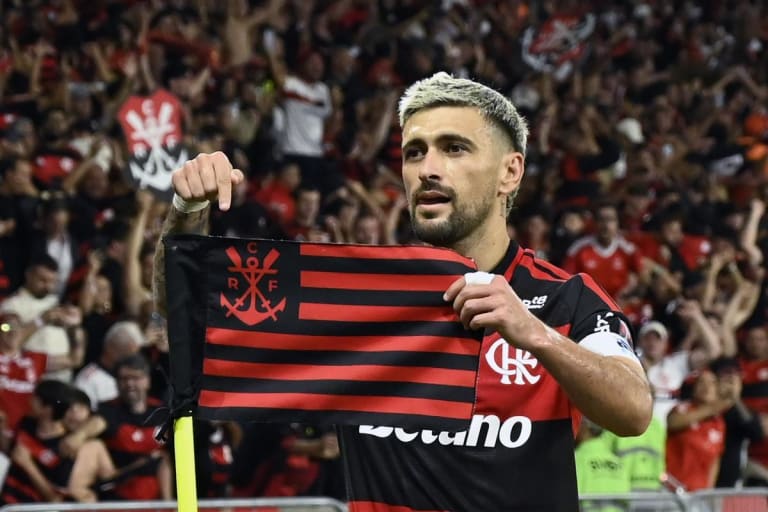
This new policy already impacts Flamengo, which currently has 11 foreign players on its roster. The list includes names like Rossi, De La Cruz, Arrascaeta, Varela, Viña, Plata, Valencia, Pulgar, Saúl, and Jorge Carrascal. With the limitations imposed by the CBF, the club will have to make important decisions to comply with the new quotas starting next year, possibly releasing some players.
Other Similar Cases in the Brasileirão
Jorginho is not the only player in a peculiar situation in Brazilian football. Seven other athletes playing in the Brasileirão are also not counted as foreigners, despite their international careers or affiliations with other national teams. Among them are:
- Maurício (Palmeiras): Brazilian who plays in Paraguay.
- Carlos Coronel (São Paulo): Brazilian who played in Paraguay.
- João Costa (Cruzeiro): Brazilian who played in the youth categories for the Portugal National Team.
- Rafael Tolói (São Paulo): Brazilian who played in Italy.
- Matheus Reis (Fluminense): Mexican naturalized Brazilian.
- Niclas Eliasson (Internacional): Swede with a Brazilian mother.
- Kannemann (Grêmio): Argentinian naturalized Brazilian.
Criticism of the New CBF Rule
The CBF‘s decision to restrict the number of foreign players was not well-received by everyone. Flamengo‘s football director, José Boto, vehemently criticized the measure, arguing that it could weaken Brazilian football. In statements to reporter Mônica Alves of Coluna do Fla, Boto expressed his concerns.
— _As a foreigner, who works in Brazil but has worked in other leagues, I will give my opinion, although I respect, obviously, those who did these studies. It doesn’t seem to me that this measure will help Brazilian football; on the contrary, it will make the league weaker, because players will continue to leave_ — said Boto.
The Portuguese executive also warned of the risk of talented players leaving prematurely for the European market and the consequent drop in the national league’s technical quality.
— _The best players will continue to leave for Europe very young, and clubs, not having the possibility to retain these valuable players, will have to play with less valuable players, and this will lower the quality of the Brazilian league_ — he added.
The discussion about the number of foreign players and the development of national football promises to keep the behind-the-scenes discussions at Brazilian clubs buzzing. Flamengo, with its squad full of international talent, will have an extra challenge in adapting to the CBF‘s new directives in the coming years.
By M360 Team