


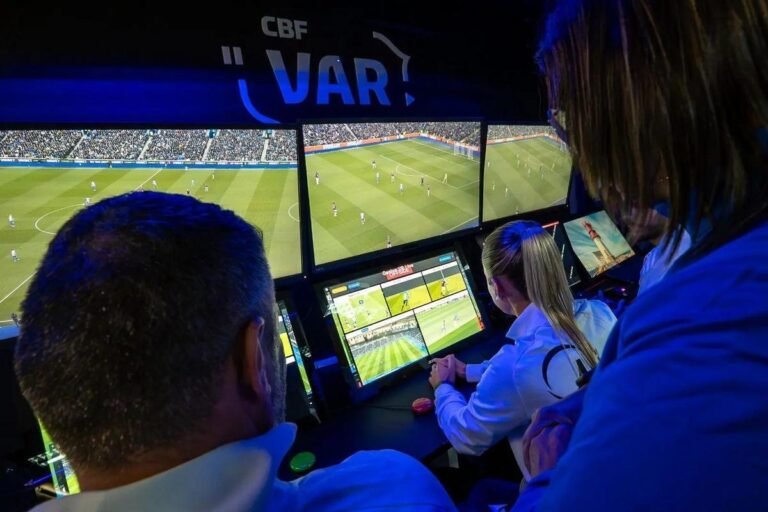
The Brazilian Championship just took a leap into the future! The CBF has approved the use of semi-automated offside technology following a remarkable debut in the 20th round, promising more agility and accuracy for Brazilian football.
The 20th round of the Brazilian Championship marked a historic turning point for national refereeing. For the first time, semi-automated offside technology was implemented on Brazilian pitches, bringing with it the promise of faster and fairer decisions. After the footballing weekend concluded, the Brazilian Football Confederation (CBF) did not hesitate to ratify the use of the tool, which proved effective in five crucial checks across four different matches.
The immediate approval by the CBF highlights the initial success and the confidence placed in this innovation. It is a bold and essential step to elevate the standard of Brazilian football, aligning it with the highest international refereeing standards and minimizing room for controversy.
The Revolution of Agility and Precision
The assessment of the debut was overwhelmingly positive, as highlighted by Netto Góes, CBF’s Refereeing Director. According to him, “the first weekend of official use of semi-automated offside was extremely positive and confirmed that we are on the right track. The technology delivered what we expected: more agility, precision, and security in decisions, significantly reducing the analysis time of plays and providing greater fluidity to the matches.” This speed, with an average check time of just 47 seconds, promises to transform the experience for fans and players, making the game more dynamic and less interrupted by lengthy VAR reviews.
Successful Partnership and Looking Ahead
The success of this first phase is no accident. Netto Góes emphasized that the result is “the fruit of great planning, integration between the CBF, Genius Sports, clubs, refereeing teams, and all professionals involved in the operation.” This strategic collaboration is fundamental for continuous evolution. The CBF has already signaled that it will continue to monitor and improve the processes, ensuring that Brazilian football incorporates international-standard technology, always aiming for increasingly efficient, transparent, and, above all, reliable refereeing.
Key Plays from the Debut
The technology made its debut on Saturday during the exciting clash between Santos and Chapecoense at Vila Belmiro, validating Marcinho‘s goal for the Santa Catarina team. On Sunday, the impact was even greater: in the Flamengo vs. São Paulo match at the Maracanã, Calleri‘s goal was confirmed, and one by Samuel Lino was disallowed. At the Fonte Nova stadium, the technology intervened to disallow Alejo Véliz‘s goal for Bahia against Corinthians. Finally, at the Mangueirão stadium, in Remo‘s victory over Vitória, the second goal for the Pará team was correctly confirmed, attesting to the system’s effectiveness.
The implementation of semi-automated offside is more than just a technological update; it is a watershed moment that projects the Brazilian Championship into a new era. With clearer and swifter decisions, Brazilian football takes a giant step towards modernity and sporting justice, strengthening the passion that moves millions of fans. The expectation is that this novelty will bring even more credibility and excitement to the competitions, celebrating football in its purest essence.
By Mengão 360