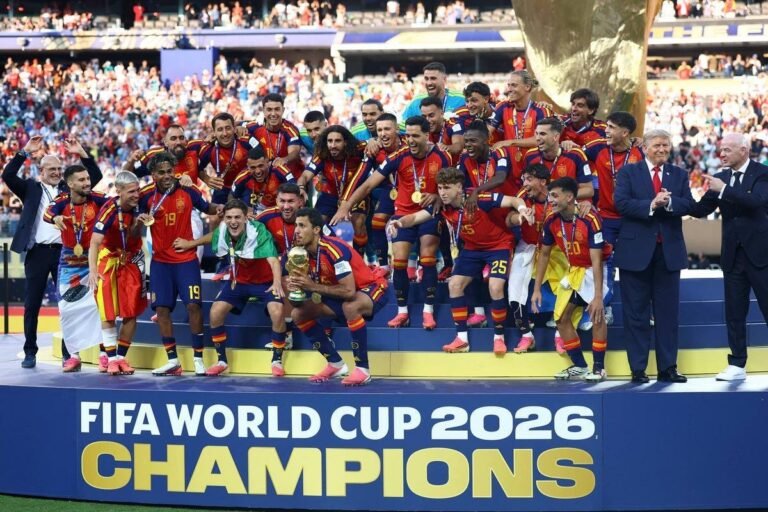


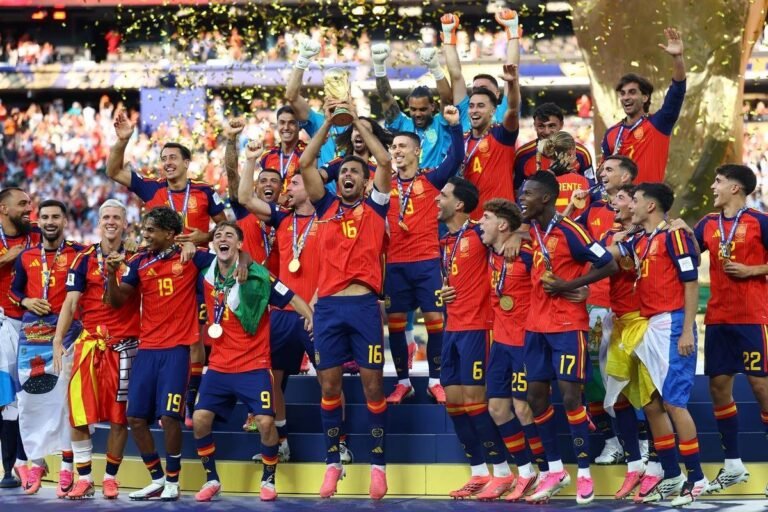
Spain has rewritten football history with an overwhelming collective performance in the 2026 World Cup final, subduing Argentina in a display of spirit, love, and passion for the beautiful game!
The 2026 World Cup culminated in a final that will be remembered not for the anticipated tension and balance, but for the categorical dominance of one giant over another. The Spain national team, crowned champions, demonstrated to the world the power of a cohesive football project, overwhelming Argentina with a performance that bordered on tactical and technical perfection. It was not just a victory, but a statement of principle on what team football can achieve.
The most significant aspect of this result is this Spanish supremacy. Far from a clash of titans on equal footing, the match unfolded as a masterclass in control and efficiency, where Luis de la Fuente‘s side completely dismantled Argentine hopes, leaving them unable to respond to La Roja’s total football. The disparity on the pitch shocked even the most optimistic observers.
A Final Without Rivalry: Spanish Dominance
The World Cup final scoreline alone did not capture the full extent of the Spanish dominance. The statistics are staggering: Spain recorded 20 shots compared to just two from Argentina, with 12 of those forcing saves from Emiliano Martínez, while Unai Simón did not face a single shot on target. Such a scenario is rare in matches of this magnitude, highlighting a level of authority seldom seen on such a grand stage. Spain, with its passion for control, simply gave them no chance.
Argentine Anguish and the Dismissal of Enzo Fernández
Argentina, on the other hand, experienced a nightmare on the pitch. The team, which relied on the grit of its people and the genius of Lionel Messi to overcome obstacles, found itself powerless. Frustration turned into nervousness, resulting in 24 fouls committed. The height of their disillusionment came with the expulsion of Chelsea’s Enzo Fernández late in regulation time after receiving two yellow cards. Despite the referee’s leniency on several rougher challenges, the Argentine intensity bordered on recklessness without ever achieving competitiveness.
The DNA of Victory: The Spanish System
Spain’s near-perfect campaign, in which they conceded only one goal, is a testament to their defensive solidity and an enviable playing system. The style of Luis de la Fuente, which prioritizes ball control and the harmonic functioning of the collective, found its best version. Even with the individual brilliance of young talents like Lamine Yamal, the team did not rely on a single star, but rather on the orchestration of a renewed tiki-taka, featuring more verticality and purpose. It is a prize for well-organized team football.
Contrast in Styles and Mental Fatigue
While Spain was able to manage injuries and maintain their standards, Argentina felt the weight of their excessive dependence on Lionel Messi, exacerbated by the absence of a player like Di María, who previously provided creative balance. The physical and mental exhaustion of the Argentine squad was palpable and translated into total ineffectiveness against the Spanish force. The resilience that carried them to the final was not enough to rival such a well-prepared side.
Spain’s victory in the 2026 World Cup is not just a title; it is the consecration of a philosophy. It is proof that a well-developed “Spanish DNA,” rooted in youth academies and focused on collectivity and a robust system, can lead to the pinnacle of world football. This triumph projects a future where La Roja, with their passion for strategic and beautiful play, will continue to be a global benchmark, inspiring generations with the power of a project that transcends the field.