

CBF Presents Balance Sheet and Projects National Teams for 2027 and 2030 to Federations
CBF Presents Financial Report and Charts Future for Men’s and Women’s National Teams in Meeting with State Federations.
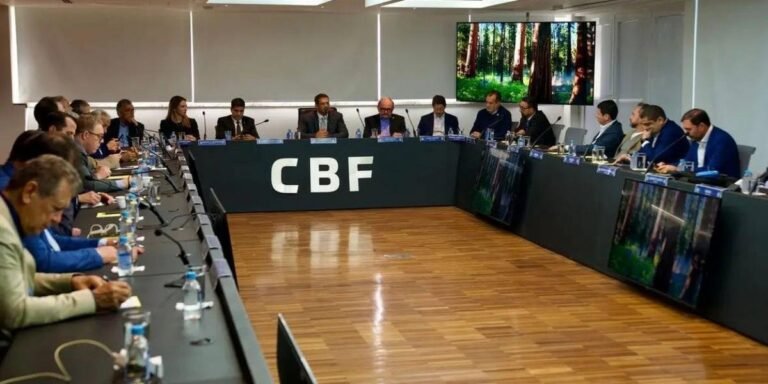
The Brazilian Football Confederation (CBF) opened its doors to state federations this Tuesday (14), presenting a detailed balance sheet of its first year in office and, more importantly, outlining the paths for the Brazilian men’s and women’s national teams. The meeting served as a platform to disclose ambitious plans targeting both the preparation for the 2027 Women’s World Cup, which Brazil will proudly host, and the beginning of the men’s national team’s cycle for the 2030 Fifa World Cup.
A New Direction for Brazilian Football
The current CBF management has been dedicated to implementing significant changes. Among the prominent actions are the reform of the national football calendar, the establishment of working groups focused on crucial topics such as Financial Fair Play, refereeing improvements, and youth development. Furthermore, the resumption of institutional dialogue with clubs and federations marks an effort to strengthen the foundations of the sport in the country.
CBF President Samir Xaud acknowledged that expectations were not fully met in the last World Cup but emphasized the importance of transparency regarding the hard work being done.
“Of course, we expected a more positive result [in the 2026 World Cup], but it is important to show everything that is happening: the work being done in youth development, with integration between categories, both in men’s and women’s football,” stated Xaud. He added, conveying optimism and a vision for the future: “So the work doesn’t stop, it’s continuous. We’ve turned a page and are now refocusing on the Women’s World Cup, as well as the 2030 cycle.”
Men’s Team: Looking Towards 2030 with Ambition
The presentation for the men’s national team included the participation of executive coordinator Rodrigo Caetano. He detailed the preparation for the last World Cup, mentioning the arrival of renowned coach Carlo Ancelotti and the strategy of facing opponents with different playing styles. A relevant statistic revealed was that 23 out of the 26 players called up for the last tournament had played for youth national teams, highlighting the development work. For the next cycle, the objectives are clear: winning the 2028 Copa América and qualifying for the 2030 World Cup.
Women’s Team: Towards the Home World Cup
Women’s national team coach Arthur Elias presented a robust plan for the 2027 Women’s World Cup. Preparation will include four FIFA Dates between October 2026 and April 2027, with friendlies against powerhouses like Japan. The schedule is detailed, anticipating call-ups in May 2027, an intensive training period at Granja Comary in June, a preparatory friendly on the 13th, and the World Cup debut on June 24th. The CBF assures that the work is structured on fundamental pillars, such as team identity, playing model, and tactical plan.
Refereeing: Transparency and Modernization in Focus
In the area of refereeing, director Netto Góes presented the new board, focused on governance, transparency, technology adoption, training improvement, and international strengthening. The appointment of Sandro Meira Ricci as president of the CBF Refereeing Commission reinforces the commitment to excellence and modernization of the sector.
The meeting with the state federations demonstrates the CBF‘s intention to align strategies and strengthen communication for the development of Brazilian football. The focus on clear goals for both the men’s and women’s national teams points to a promising future, with the passion for the sport as the main driving force.