
The CBF held a strategic meeting with federations to assess its first year in office, formalizing the Brazilian National Teams‘ preparation schedule for the 2027 and 2030 cycles.
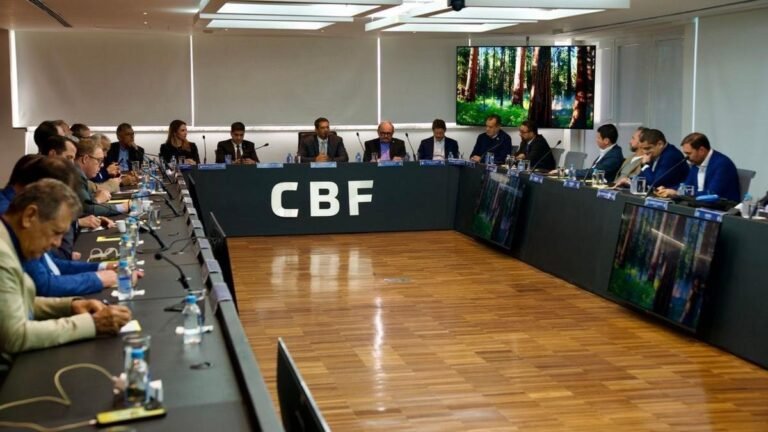
The Brazilian Football Confederation (CBF) held a crucial meeting this Tuesday (14) with vice-presidents, directors, and presidents of state federations. The central objective was to present a detailed review of the current administration’s first year, highlighting structural achievements and, above all, to outline the future of the Brazilian National Teams.
The meeting marks a phase of rebuilding and full focus on the next major challenges. With an eye on the 2027 Women’s World Cup, which will be hosted in Brazil, and the long-term planning for the Men’s National Team for the 2030 World Cup, the entity seeks to align the expectations of all of Brazilian football.
Review of the First Year of Management
President Samir Xaud‘s administration has consolidated important reforms in this initial cycle, such as the restructuring of the calendar and the creation of working groups focused on Financial Fair Play, Refereeing, and Youth Categories. For the board, constant dialogue with clubs is the key to progress.
“Of course, we were hoping for a more positive result (in the Men’s World Cup), but it’s important to show everything that’s happening: the work being done at the youth level, with integration between categories, both for men and women. So the work doesn’t stop, it’s continuous. We’ve turned a page and now we’re refocusing on the Women’s World Cup, in addition to the cycle for 2030,” stated Samir Xaud.
The Road to the First Women’s Star
Coach Arthur Elias detailed the schedule for 2027, which positions Brazil as the protagonist. The planning focuses on high-level friendly matches, with intensive preparations at Granja Comary. The goal is clear: to leverage home advantage and a consolidated playing identity to win the unprecedented title.
For the Men’s National Team, coordinator Rodrigo Caetano highlighted the importance of well-defined cycles and integration with the youth teams. The focus now shifts to the 2028 Copa América and a solid campaign in the World Cup Qualifiers, aiming for the 2030 edition.
Institutional Recognition and Advances in Refereeing
The meeting also served to introduce Sandro Meira Ricci as the new president of the CBF Refereeing Committee. The new board is betting on transparency and technology to raise the level of matches. The president of the São Paulo Football Federation, Reinaldo Bastos, praised the management’s stance, emphasizing that Brazilian football is experiencing a moment of necessary unity and rebuilding.
With all 27 state federations aligned, the CBF reinforces its commitment to participatory management. The next period will be decisive in consolidating these advances and ensuring that Brazilian football shines again on the global stage, with planning, technique, and, above all, the DNA of our Seleção (national team).