

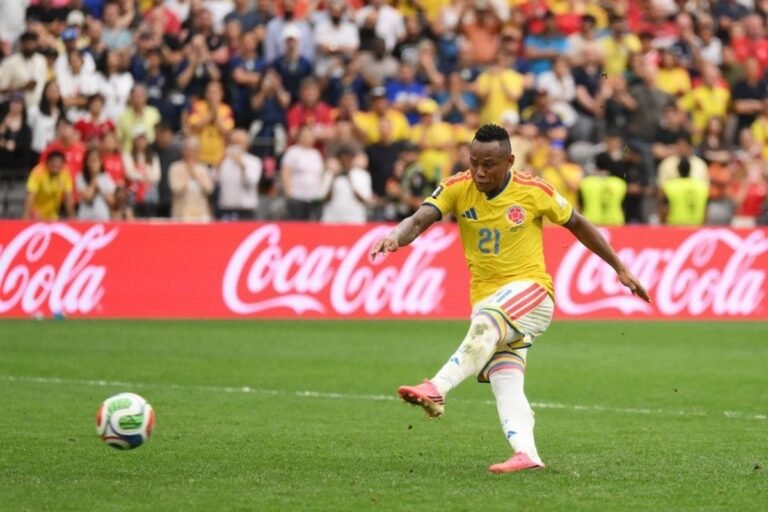
The passion for soccer spills over into violence. Colombia player Jaminton Campaz receives death threats after the national team’s elimination from the 2026 World Cup, shocking the sports world.
The magic of the 2026 World Cup, which should have been a stage for celebration and camaraderie among nations, was brutally stained by an episode of intolerance and hatred. Amidst the intense battle for a spot in the quarterfinals, the passion that drives the sport crossed unacceptable boundaries, transforming the sadness of defeat into death threats directed at an athlete. The unfortunate protagonist was midfielder Jaminton Campaz of Colombia, who, after his national team’s elimination, found himself a victim of a dangerous wave of fanaticism.
The most dramatic point of this regrettable story lies in the cruelty of singling out a single player as responsible for a collective result. The frustration with Colombia‘s exit against Switzerland in the Round of 16, decided by penalties after a goalless draw, turned into a personal attack against Campaz, a clear demonstration of how uncontrolled emotion can distort the values of sport and society itself.
The Thin Line Between Passion and Hatred
The scenario that led to the threats against Jaminton Campaz was the decisive match in Vancouver, Canada, where Colombia faced Switzerland. In a tense game, the midfielder missed a clear goal-scoring opportunity, a moment that, in the view of some extremist fans, made him the primary culprit for the elimination. The 4-3 loss in the penalty shootout sealed Colombia’s fate, and irrational fury erupted on social media, exposing the darkest side of a fanbase that ignores the principles of respect and fair play.
An Athlete’s Outcry
Faced with the wave of hostility, Jaminton Campaz used his social media to make an emotional statement and a plea for reason. In his words, he called for an environment where respect prevails over frustration, reiterating the message that the passion for soccer cannot be a pretext for hatred.
“Soccer also has difficult moments. My Colombia, please, let us never lose sight of respect. We can think differently, feel frustration or sadness, but no passion justifies hatred or living in fear.”
The FCF’s Institutional Response
The severity of the threats prompted the Colombian Football Federation (FCF) to issue a strong statement of repudiation and unconditional support for Campaz and his family. The entity demonstrated solidarity and highlighted the intolerability of any intimidation against athletes representing the country. The player, who plays for Rosario Central-ARG, received all the necessary institutional support during this delicate time.
The FCF did not limit itself to words, formally requesting that the Attorney General’s Office initiate a swift investigation to identify, prosecute, and punish those responsible for the threats. The message is clear: soccer should be a space for unity and hope, never violence.
“The Colombian Football Federation (FCF) categorically rejects the threats against the life and integrity of Jaminton Campaz and his family. No athlete should be subjected to intimidation for representing their country in a sporting context. Soccer should be a space for unity, respect, and hope, never a stage for hatred, intimidation, or violence.”
A Warning for Soccer
The regrettable incident involving Jaminton Campaz serves as a painful warning for the world of soccer. The pressure on players is immense, and turning them into scapegoats for collective frustrations is a dangerous path that distorts the essence of the sport. It is essential that fans, federations, and authorities work together to combat the culture of hatred and ensure that the emotion, grit, and passion we love so much in soccer are never a justification for acts of cowardice and threats to life.
This sad chapter of the 2026 World Cup reinforces the urgency of educating and raising awareness, so that genuine passion for the sport does not become a tool for violence. The safety and integrity of athletes must be non-negotiable priorities, ensuring that the brilliance of the pitches is not overshadowed by the shadow of intolerance and fear. The journey of Campaz and Colombia in the World Cup may have ended, but the fight for a more human and respectful soccer continues.