

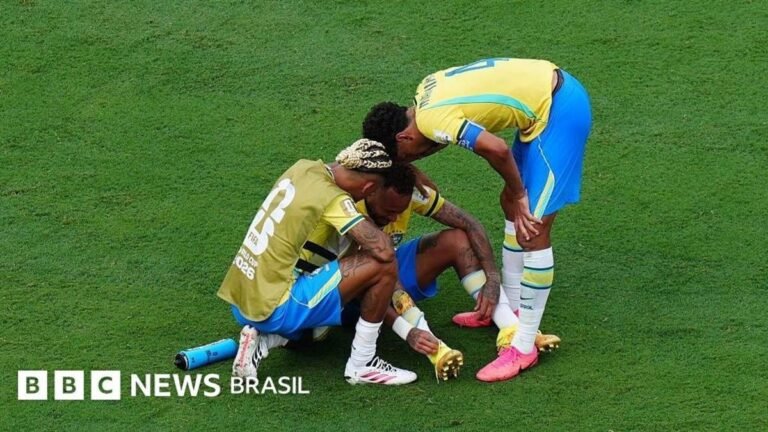
Brazil’s elimination from the 2026 World Cup can be summarized in three numbers. The first is 33.5% — the share of possession Carlo Ancelotti‘s team had in their 2-1 defeat to Norway this Sunday (5th) at MetLife Stadium in New Jersey. The second is 1990 — the last year Brazil was knocked out of a World Cup this early, back then by Argentina. The third is 28 — the minimum number of years that will separate the 2002 title from a potential sixth championship, now only possible from 2030 onwards. It is the longest drought in the national team’s history.
For journalist and author Samindra Kunti, who has covered the Brazilian national team for decades, written a book about the squad, and is a contributor to the BBC, these figures do not describe an accidental mishap. “This was probably Brazil’s worst World Cup campaign since 1990 — and in my lifetime, the worst I have covered and watched,” Kunti told BBC News Brasil. “And to me, everything points to a structural decline. In a sense, this campaign and the elimination were the perfect storm: all the factors that led to this decline came together.”
The first of these factors, according to him, is external — but the Brazilian reaction to it is the core of the problem. “Brazil has simply been overtaken by Europe. Europe has industrialized its youth development and its talent production. The examples are numerous: Belgium, the Netherlands, Croatia, England, France, and to some extent, Norway,” he states. “And there is, I think, a sense of denial in Brazil. When you talk to Brazilian journalists or coaches, the narrative is always: ‘we are five-time world champions, we are the team of football.’ But the reality is that other nations have developed their systems for training and scouting talent. No matter how great Brazil is in footballing and geographical terms, you can no longer hide behind the idea that, as a nation, you will always produce talent, no matter what happens.”
This assessment is shared by American historian Gregg Bocketti, a professor at Transylvania University and author of The Invention of the Beautiful Game, a book about the construction of football as a Brazilian national identity. “It is remarkable that since their last victory in 2002, the team has only reached one semifinal — at home in 2014,” Bocketti told BBC News Brasil. “I think this most recent elimination is a symptom of a deeper, longer decline where we can no longer assume the national team starts the World Cup as one of the favorites — nor be surprised when they fall in the early stages.”
‘A very mediocre generation’
In Kunti‘s reading, the squad taken to the United States is a portrait of this declining production line — not for a lack of valuable players on the transfer market, but due to a shortage of top-tier stars. “If you ask yourself how many global superstars are playing on this team, I think the answer is very limited. It is Vinícius Júnior, obviously, and you could argue that Gabriel and Marquinhos, in defense, are also world-class players,” he says. “But aside from them, this is a very mediocre generation of Brazilian players. They are not the stars of the squads of the past, when you had Kaká, Ronaldo, Rivaldo, Roberto Carlos, Cafu — all household names worldwide.”
This diagnosis exists alongside a paradox that transfer market figures highlight — and, at the same time, confirm. Brazil leads the CIES Football Observatory‘s world ranking for player exports for the seventh consecutive year: there are 1,455 Brazilians playing abroad, ahead of France (1,275) and Argentina (1,066), according to the report released in May. No country produces more footballers. But when the criterion shifts from quantity to value, the position changes: the squad taken to the World Cup is only the sixth most valuable in the tournament, valued at approximately R$ 5.5 billion (€943 million) by Transfermarkt — behind England (approx. R$ 9.4 billion), France, Spain, Germany, and Portugal. In other words, the market itself has already priced in what Kunti describes: Brazil remains the world’s largest football production line, but has ceased to be the factory of the elite.
For Bocketti, even the price tag does not escape skepticism. “I think it is reasonably accepted that Brazilian players tend to be overvalued — the ‘Brazil‘ brand is still strong enough to command higher transfer fees than actual talent would justify,” he assesses. And the mass export model, the historian argues, comes at a price that doesn’t appear on balance sheets: the lack of a collective identity. “As Brazilian commentators have long lamented, developing a culture and a team style becomes more difficult when the national team players play not only for many different clubs, but in many different countries, each with its own footballing culture. The export-led football model means the national team is talented but incoherent.”
The expert believes the decline in results has a lot to do with “the hollowing out of the Brazilian Serie A and other domestic leagues, as almost every promising Brazilian player is lost to more prosperous leagues before completing their physical and tactical development.” However, he sees a glimmer of hope in the opposite direction: the improving economic position of Brazilian clubs, which are beginning to repatriate players in their prime — citing the examples of Lucas Paquetá at Flamengo and Vitor Roque at Palmeiras.
A 38-year-old bogeyman: Brazil has never beaten Norway
Sunday’s defeat also extended one of the most unique streaks in international football: in five encounters over 38 years, Brazil has never defeated Norway — three losses and two draws. The history begins in 1988 with a draw in a friendly in Oslo. In 1997, again in the Norwegian capital, Norway won 4-2. A year later came the most famous chapter: in the 1998 World Cup group stage, the Norwegians turned the game around in the final minutes to win 2-1, with a penalty converted by Kjetil Rekdal. The fifth meeting was this Sunday’s — the first in a knockout round, and the one with the highest stakes. On the pitch, the narrative condensed the team’s contradictions. Brazil missed a penalty with Bruno Guimarães in the first half, and Norway only opened the scoring in the 79th minute. It was enough for Erling Haaland to decide the match with goals in the 79th and 90th minutes. Neymar scored a consolation goal from a penalty in stoppage time.
The Norwegian project: Talent maximized — and in cycles
Who is Norway, after all? A country of 5.5 million inhabitants — less than the population of the city of Rio de Janeiro — that hadn’t played in a World Cup since 1998 and had never passed the Round of 16. The qualification for the quarterfinals against Brazil is the best performance in their history. For Kunti, it is not a fluke, but it isn’t magic either: it is the maximum utilization of a good squad, built by a federation that has professionalized. “If you look at the Norway squad, it is quite talented. They have the talisman Haaland, they have Martin Ødegaard, but also other talents, such as Julian Ryerson on the wing and Oscar Bobb. Perhaps it isn’t a world-class team in every position, but they used what they had in the squad and maximized it,” he analyzes.
Ancelotti, the wasted cycle, and the calendar that stifles ideas
The CBF confirmed, hours after the elimination, the stay of Carlo Ancelotti, with a contract until 2030. Kunti views the manager issue with nuance. First, the context: “Ancelotti had very little time to work with this team after the CBF basically wasted almost the entire post-2022 World Cup cycle.” Then, the assessment: “This is a personal point of view, but I think Ancelotti is the wrong manager for Brazil. The problem is that he is a pragmatic coach: he looks at the squad, sees which players he has at his disposal, and builds the team from there. I don’t know if that is enough.”
He considers the hiring of a foreigner a success — for what it reveals about the domestic environment. “It is great that Brazil appointed its first foreign manager in modern history because Brazilian football needs ideas. The domestic calendar does not allow coaches to develop any ideas — it is relentless, and the media and fans just want to win the next game,” he asserts. He recalls that recent counterexamples came from abroad: “Jorge Jesus arrived at Flamengo in 2019 and showed that you can play progressive football, win with attacking football, and a true philosophy. Abel Ferreira, at Palmeiras, has a totally different philosophy… but both Portuguese managers show that it is possible to work around philosophies. Few Brazilian coaches do that, with exceptions like Tite.”
Bocketti notes that if reconstruction requires planning, Brazil doesn’t need to go to Scandinavia to find a model: it just needs to reread its own history — and dismantle a myth. “As I write in The Invention of the Beautiful Game about the incredible successes of the 1958-1970 period: ‘Many ignored the unprecedented level of planning by officials and the uncommonly intense training sessions of the national team, preferring to portray this Golden Age as the natural result of the instinctive genius of Brazilians for the game.’ In other words: Brazilian football can look at its own history to find examples of how planning and care create the conditions for success.”