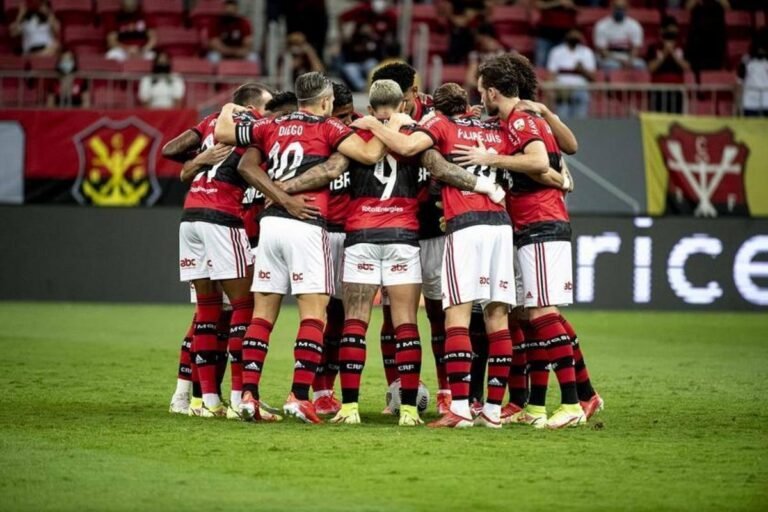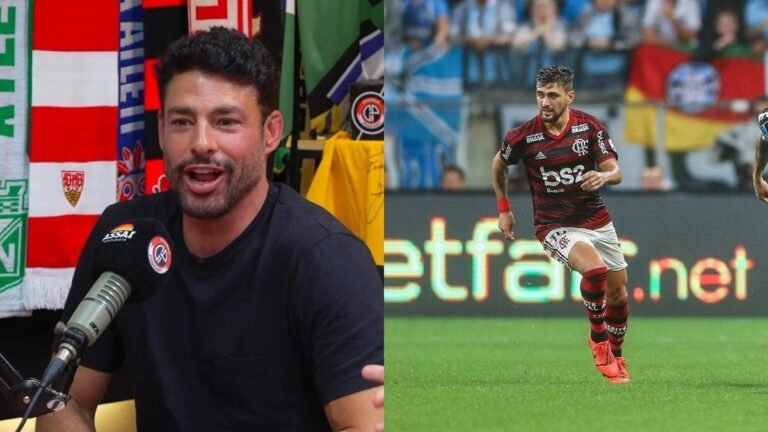

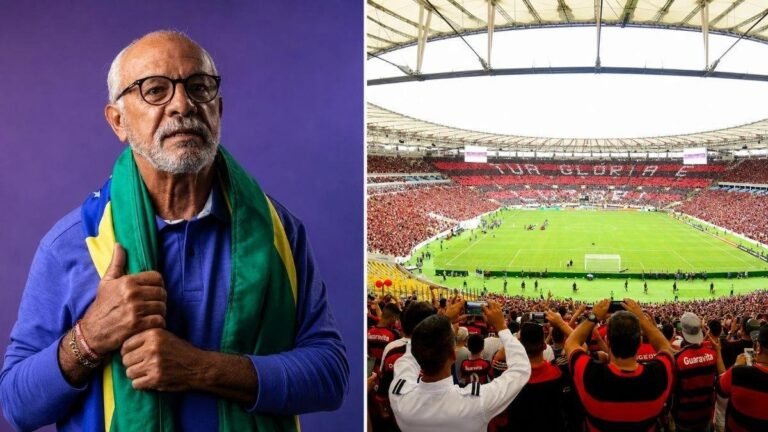
A club legend, Maestro Junior, did not hold back his criticism of the team’s recent change in behavior at the Maracanã, as they have stopped attacking towards the North stand in the second half.
The relationship between Flamengo and the Maracanã has always been governed by a mystique that goes beyond the four lines. Historically, the red-and-black team usually invests in an attacking strategy towards the North side — to the left of the broadcast booths — during the final half of matches, seeking direct support from the fans in decisive moments.
However, the abandonment of this practice in recent commitments has generated strong discomfort among legends and fans. Former player and eternal idol Junior, in statements shared on his social media, expressed indignation with what he considers a fundamental break in tradition.
The Maestro emphasized that, for generations, the team has used this tactic as a psychological and technical advantage to pressure opponents and achieve historic comebacks.
Breaking the Custom in Recent Games
The survey conducted by the M360 Team confirms that Flamengo has failed to follow the usual script in its last three appearances at the stadium, facing opponents such as Cusco, Coritiba, and São Paulo. In these matches, the team inverted its attacking side, choosing to finish the game against the South stand.
Although the sporting performance has maintained a positive balance — with two wins and one draw —, the cultural issue raised by the idol has gained traction behind the scenes at Gávea.
Certain traditions cannot be broken. Attacking in the second half towards where the most traditional fans are has been a practice for as long as I can remember. Opponents knew it and, when they won the coin toss, they chose to take us away from this tradition.
The red-and-black idol reinforced the importance of the winning mystique that accompanied epic achievements in the 80s and 90s.
History of Glory Attacking Towards the North
Junior‘s claim is supported by the archives of Mais Querido‘s history. Memorable goals, such as Rondinelli‘s in 1978 and Nunes‘s Brazilian championship-winning goal in 1980, were scored precisely at the goal situated to the left of the broadcast booths.
The list of successes continues with the third national title in 1983, the Libertadores semifinals in 2019 and the 2022 final, as well as Petkovic‘s iconic goal against Vasco in 2001.
For upcoming commitments, the expectation is that the team’s leadership, spearheaded by players like Arrascaeta and Bruno Henrique, will evaluate the impact of this change. The next challenge in the Brazilian Serie A, scheduled for August 9 against Vitória, will be a test to see if the club will return to its traditional field preference after the coin toss.
The M360 Team is closely monitoring whether Leonardo Jardim‘s coaching staff will align the team’s behavior with the demand to keep the fans’ flame alive, or if the decision will continue to focus purely on momentary tactical aspects.
The debate about preserving these traditions promises to remain heated on social media and in the Nação’s discussions.
Equipe M360