
Brazilian clubs are fueling a billion-real investment surge in the Libertadores Round of 16, with Flamengo, Palmeiras, Cruzeiro, and Fluminense ranking among the highest spenders.
The 2026 Conmebol Libertadores Round of 16 promises intense excitement, set against a financial backdrop that highlights the dominance of Brazilian clubs. With six representatives in this decisive phase, the national football scene is flexing its investment muscle, concentrating a large portion of the competition’s total transfer spending. This financial input reflects a shared ambition to lift the continent’s most coveted trophy.
Four of the five clubs that have invested the most in new signings this season are from Brazil, highlighting an arms race in pursuit of continental glory. The heavy investment from Brazilian clubs not only raises the technical level of their squads but also intensifies domestic and international competition, turning every match into a true spectacle.
Brazilian giants lead the spending
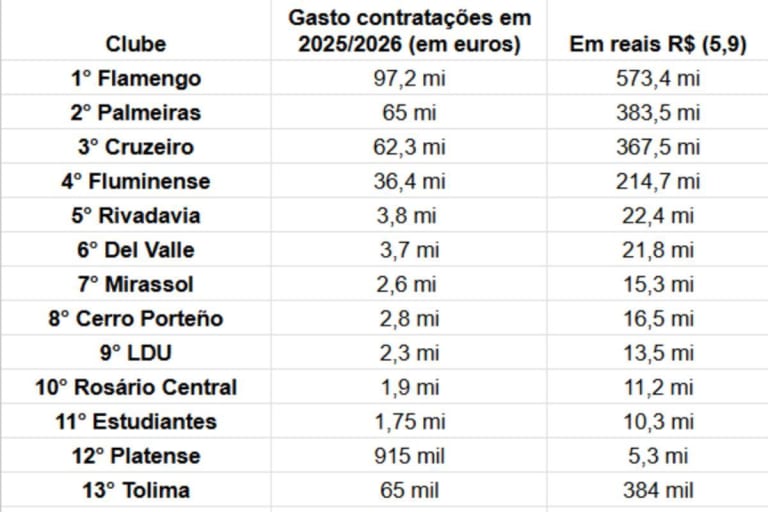
A detailed survey reveals that Flamengo stands out as the highest spender, with R$ 573.4 million in signings since August 2025. Palmeiras follows closely, contributing R$ 383.5 million, while Cruzeiro occupies third place with R$ 367.5 million. Fluminense completes the quartet with R$ 214.7 million in expenditures. Combined, the Brazilian clubs in the Round of 16 represent an impressive investment of R$ 1.54 billion in reinforcements, underscoring their financial hegemony in the tournament.
High-profile reinforcements and million-euro transfers
These astronomical figures have translated into high-caliber players. Flamengo, for instance, brought in Lucas Paquetá for 42 million euros from West Ham and Samuel Lino for 22 million euros from Atlético de Madrid. Palmeiras secured John Árias for 25 million euros from Wolverhampton, and Cruzeiro invested 27 million euros in Gerson, from Zenit. These marquee names reinforce the clubs’ intention to build competitive squads for the knockout stages.
Market strategies: Contrasts across the continent
While the Brazilians are opening their coffers, clubs from other countries, especially Argentina, are adopting a more cautious approach. With the exception of River Plate, many Argentine teams have focused on signing free agents at zero cost. A notable example is Di María, who signed with Rosário Central after his contract with Benfica expired. Independiente Rivadavia, Fluminense‘s opponent, was the Argentine club that invested the most, spending 2.5 million euros on Álex Arce from LDU—a figure still far below that of the Brazilian giants.
Betting on zero-cost moves
Beyond the Argentines, Corinthians also stood out for a market strategy focused on zero-cost deals, reinforcing their squad with free agents such as Gabriel Paulista, Jesse Lingard, and Zakaria Labyad. Similarly, Universidad Católica and Coquimbo, both from Chile, have recorded zero transfer spending since mid-2025, seeking to optimize their budgets without compromising the competitiveness of their rosters.
The 2026 Libertadores is shaping up to be a showcase of Brazilian financial power in South American football. The heavy investment aims not only for the title but also to solidify regional hegemony. With matches becoming increasingly balanced and squads packed with talent, the expectation is for a decisive phase filled with major games, where each club’s strategy will be tested to the limit. Follow the complete coverage by the M360 Team for more details on the competition’s next steps.
M360 Team