
Flamengo Solidifies Dominance as Brazil’s Largest Fan Base, Datafolha Survey Reveals
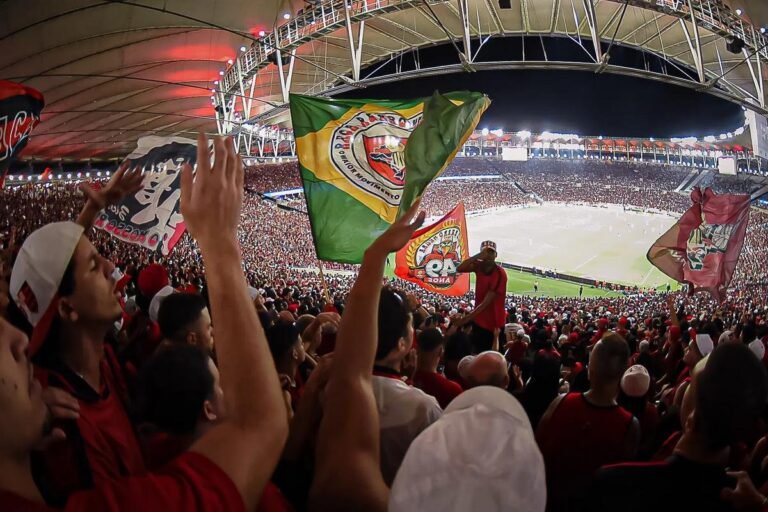
A new Datafolha survey, released this Saturday, confirms what was already expected: Flamengo maintains its prominent position as the club with the largest fan base nationwide. The study indicated that 22% of Brazilians identify as supporters of the Rubro-Negro, consolidating its leadership and widening its advantage over its main rival in the battle for popular passion, Corinthians, which ranks second with 14% of preferences.
The study details the distribution of the fan base across various regions of the country and demographic segments. While Flamengo leads nationally, Corinthians remains firmly as the runner-up. Traditional clubs such as Palmeiras, São Paulo, Cruzeiro, Vasco, and Grêmio appear in the subsequent positions, demonstrating the strength of their fan bases.
The Rubro-Negro’s Strength in Numbers
The survey, conducted on July 22 and 23 with 2,004 participants in 139 municipalities, reveals that Flamengo not only leads the overall ranking but also demonstrates strong penetration in regions such as the Northeast (29%) and the North/Central-West (34%). Even in the Southeast, where Corinthians appears numerically ahead in some metrics, the margin of error suggests a statistical tie, indicating the strong Rubro-Negro presence.
It is noteworthy that Flamengo also leads among both male and female audiences, an achievement few clubs manage to maintain. The historical series of Datafolha’s research, initiated in 1993, corroborates this dominance, showing the evolution of the Rio de Janeiro club from 17% to the current 22% of national preference, while Corinthians, for example, registered a less significant variation.
A Competitive Scenario, But with a Clear Leader
In the Southern Region, the scenario appears more divided, with the Gaúcho clubs Grêmio and Internacional leading local figures. However, in national terms, Flamengo reaffirms itself as the giant, with a fan base that spans different age groups and genders. The survey also highlights that a significant portion of Brazilians (22%) does not identify with any club, a relevant piece of data for future marketing strategies and fan acquisition.
The Datafolha survey serves as an important barometer for Brazilian soccer, revealing not only who the most popular team is but also the regional and demographic nuances of this national passion. With the consolidation of its leadership, Flamengo reinforces its position as an undeniable powerhouse in the Brazilian soccer landscape.
Equipe M360