

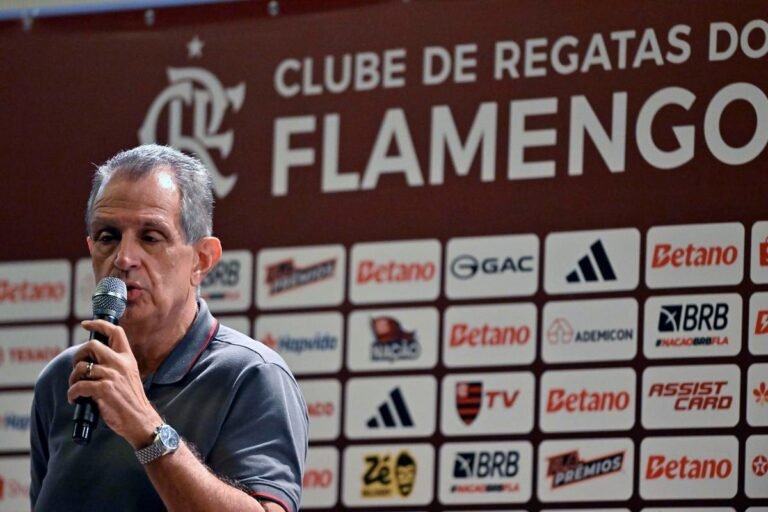
Amidst ongoing questions, Flamengo president Luiz Eduardo Baptista, known as Bap, has rebutted claims of financial negligence, detailing the renegotiation of commissions and identifying the root of a specific dispute with an agent.
The atmosphere in Rio de Janeiro football has heated up following recent controversy surrounding Flamengo and its payments to agents. Before the match against São Paulo, the Rubro-Negro president, Luiz Eduardo Baptista, known as Bap, stepped forward to clarify the situation, downplaying concerns and shedding light on the origin of the issue. The accusations of being a “deadbeat,” which were taken to the CBF by agents, were vehemently rejected by the executive.
Bap‘s firm stance aims to defend the financial integrity of the club, one of the most stable in the country, amidst a backdrop of payment restructuring. He emphasized that this is not a matter of late payments, but a strategic maneuver to adjust the Mengão‘s cash flow during a period of volatile revenue.
Strategic Financial Retreat
The executive detailed the landscape that led Flamengo to renegotiate payment deadlines. A drop in revenue from membership programs, gate receipts, and secondary product sales necessitated preventive action. The club opted to defer payments for July and August, with a promise of normalization starting in October and full settlement by the end of the year.
“First of all, here is the situation: membership revenue drops, matchday revenue drops, and revenue from business-related secondary products drops. Because of this, we gave notice two months in advance: ‘Look, this is happening. We are going to take the months of July and August and push them back; we will start paying again in October and normalize everything by the end of the year.’”
Origin of the Dispute
Contradicting the perception of a systemic problem, Bap emphasized that the initial complaint came from a single agent. He clarified that Flamengo did not enter into a broad agreement with all agents, but rather dealt with specific negotiations. The central disagreement arose from a salary increase granted unilaterally by the club to a player.
The president explained that the salary boost was a spontaneous initiative by Flamengo, without any changes to contractual clauses or intervention from the agent.
“In reality, this agreement was not widespread and is much smaller than what appeared in the media as a whole. There was a specific complaint. I won’t go into the details, but I will explain where this fight comes from. We decided to give one of our athletes a raise, unilaterally and spontaneously. We didn’t touch the player’s contract.”
Undue Commission
The core of the issue, according to Bap, lies in the agent’s attempt to charge a commission on a salary increase for which they did not work. The Rubro-Negro president was categorical in refusing such a payment, reiterating the club’s policy of rewarding its athletes directly.
“What work did the agent do? Zero. Did they change any contract clauses? Zero. Then, they send a commission bill based on what I am giving as a spontaneous raise. I said: I’m not paying that.”
The Market and Flamengo’s Credibility
For Bap, Flamengo‘s integrity in the transfer market will not be shaken by this controversy. He challenged the idea that the club would have difficulty attracting talent if it refused to pay undue commissions. The market reality, in the executive’s view, shows that Flamengo remains a desired destination for many players.
“Whoever doesn’t want to do business with Flamengo, that’s fine. Take the players out of here. Is life out there easy at other clubs? It’s not. Go ahead and do business with other clubs. Does anyone think that if I don’t pay an agent’s commission I wouldn’t be able to bring in Almada? It doesn’t make sense, right?”
Bap‘s statement before the important match against São Paulo shows Flamengo‘s intent to turn the page and focus on performance on the pitch. Confidence in the club’s financial management and the conviction that the controversy is isolated to a single agent reflect the strength and tradition of the Mais Querido, which continues to set the terms in its negotiations. The scenario now is to await the next steps from the CBF, while the Rubro-Negro maintains its position.