

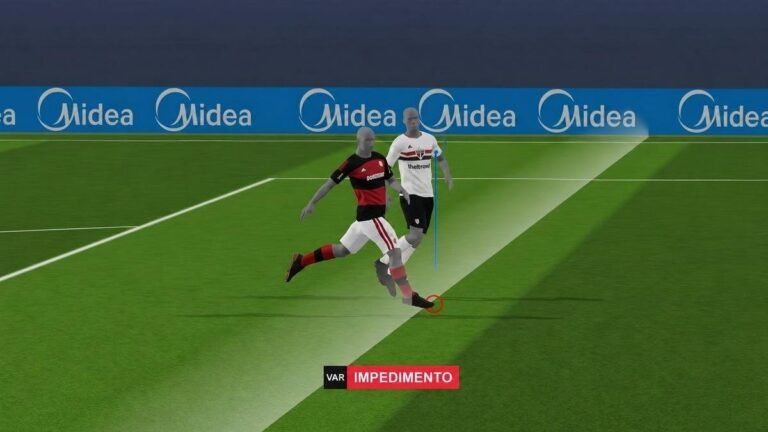
The semi-automated offside technology debuted in the Brazilian Serie A amidst criticism after a decisive Flamengo goal was disallowed, sparking debate over refereeing transparency.
The 20th round of the Brazilian Championship marked the implementation of the new semi-automated offside system. The tool, which promised accuracy, had its first critical moment during the draw between Flamengo and São Paulo. In stoppage time, the system detected a millimeter-precise offside by Wallace Yan, disallowing the goal that would have given the victory to the Rubro-Negro.
The incident ignited the stands and social media. The dissatisfaction among fans and experts isn’t limited to the decision itself, but also to the absence of images detailing the exact moment of the pass. Currently, viewers only see a 3D reconstruction with projected lines and miss the specific frame that proves the exact moment the ball was touched.
CBF Promises Adjustments to Increase Transparency
Following the repercussions, the CBF acted swiftly. The entity confirmed it is working to ensure future broadcasts include the image of the precise moment of the pass, aiming to address public doubts. Until now, this technical perspective was restricted exclusively to the VAR room.
Despite the criticism, the Refereeing Commission defends the system. Data shows that the checking time varied between 32 seconds and one minute, a significant improvement compared to the old manual tracing method, which was typically more time-consuming.
Technological Differences and Future Plans
It’s worth noting that the system implemented in the Brazilian Serie A has fundamental differences compared to the model seen in the 2026 World Cup. Unlike the World Cup, the national tournament does not use internal chips in the ball, operating instead through a complex arrangement of 28 to 32 4K cameras.
The technology, developed by Genius Sports, processes 100 frames per second to generate a precise digital replica of the players on the field. In case of a technical failure, the CBF protocol ensures an immediate return to manual tracing, maintaining the integrity of the game. For upcoming seasons, the entity is studying the introduction of RefCam and goal-line technology (GLT), solidifying the modernization of Brazilian football.
Mengão 360
RELATED NEWS
 Seven Brazilian Serie A matches today featuring Flamengo, São Paulo, Palmeiras, and Atlético-MG
READ MORE
Seven Brazilian Serie A matches today featuring Flamengo, São Paulo, Palmeiras, and Atlético-MG
READ MORE
 Brazilian Serie A: Cruzeiro, Flamengo, and Palmeiras Hit the Field This Sunday
READ MORE
Brazilian Serie A: Cruzeiro, Flamengo, and Palmeiras Hit the Field This Sunday
READ MORE
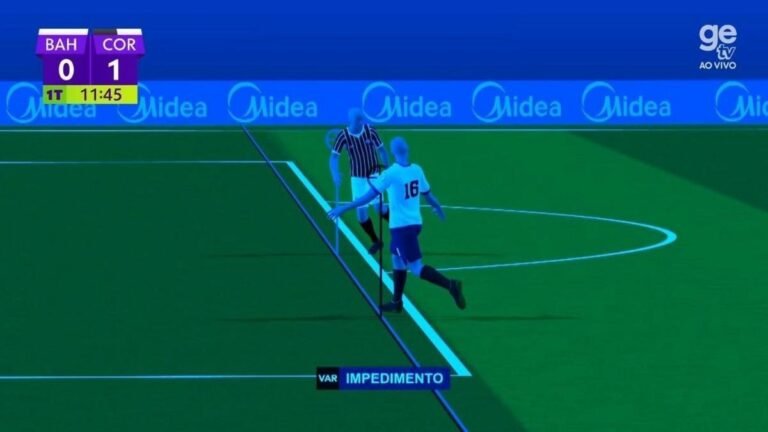 Bahia vs. Corinthians: Semi-automated technology rules out first Brasileirão goal; watch the play
READ MORE
Bahia vs. Corinthians: Semi-automated technology rules out first Brasileirão goal; watch the play
READ MORE