
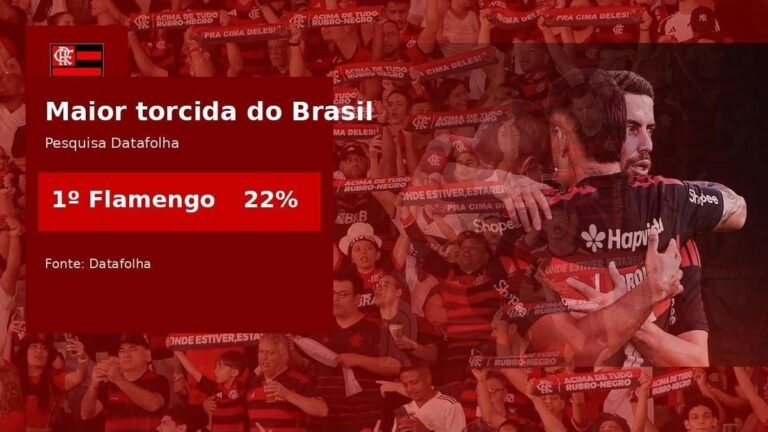
New Datafolha poll confirms Flamengo in absolute lead of supporters in Brazil, with 22% national preference, extending its lead over Corinthians.
The landscape of national passion for soccer remains unchanged, with Flamengo reaffirming its position as the club with the largest fanbase in Brazil. A new Datafolha poll, released this Saturday (01), indicates that 22% of Brazilians declare themselves supporters of the Rio de Janeiro club, consolidating its historic leadership. The survey, which covered 2,004 individuals aged 16 and over in 139 municipalities, reveals an increased distance between the red-and-black and its main rival.
Corinthians appears in second place with 14% of preferences, closely followed by Palmeiras (7%) and São Paulo (6%). The poll, conducted between July 22-23, with a margin of error of two percentage points and a 95% confidence level, also details preferences in other regions and demographic segments.
Red-and-Black Leadership in Numbers
The survey details the distribution of fanbases across the country:
- Nationally: Flamengo (22%), Corinthians (14%), Palmeiras (7%), São Paulo (6%), Cruzeiro (4%), Vasco (3%), Grêmio (3%).
- Regions: In the Northeast, Flamengo reaches 29%; in the Center-West and North, 34%. In the Southeast, there is a technical tie between Flamengo and Corinthians. In the South, Grêmio (20%) and Internacional (15%) lead, with Flamengo in third place (11%).
- Genders: Flamengo’s lead is maintained among both men (24%) and women (20%).
The historical series of the Datafolha poll, initiated in 1993, shows a consolidation of the red-and-black’s strength. The gap over Corinthians, which was minimal in 2012, has progressively grown in recent decades, driven by recent on-field success.
Impact of Recent Triumphs
Since 2019, Flamengo has experienced a golden era, winning significant titles that, according to the analysis by the M360 Team, have contributed to the growth and loyalty of its fanbase. The trophy list includes Libertadores (2019, 2022, 2025), Campeonato Brasileiro (2019, 2020, 2025), Copa do Brasil (2022, 2024), and Supercopa do Brasil (2020, 2021, 2025).