
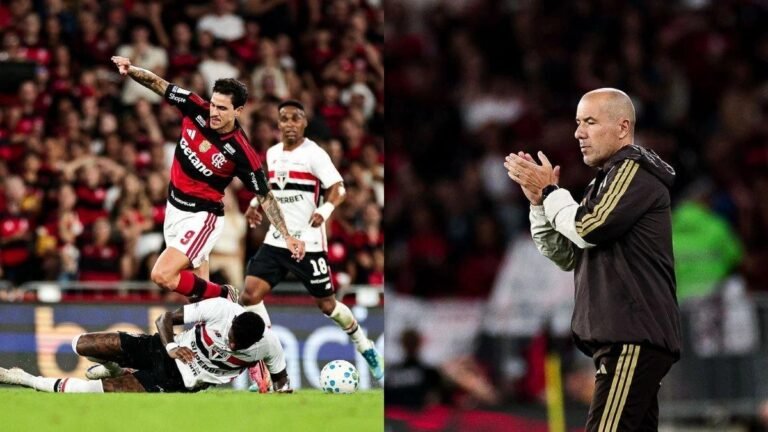
Flamengo coach Leonardo Jardim expresses frustration with the team’s initial performance and questions refereeing decisions after the draw against São Paulo.
The lingering effects of the 1-1 draw with São Paulo in the 20th round of the Brazilian Serie A still echo at Ninho do Urubu. Coach Leonardo Jardim did not hide his dissatisfaction with Flamengo‘s performance, especially in the first half, pointing to the team’s “slow pace” as one of the main reasons for the frustrating result. In his post-match analysis, the coach also directed criticism at the refereeing, represented by referee Anderson Daronco.
Critical Analysis of the First Half
Leonardo Jardim was unequivocal in describing the first half against São Paulo. He lamented the lack of dynamism and the slowness in build-up play, which, according to him, allowed the opponent to occupy spaces more easily. The need for a change in attitude and greater speed was clear to the coach, something that, fortunately, was seen in the second half.
“I think in the first half we lacked dynamism, we were slow in build-up. We allowed the opponent to occupy spaces. We needed to change our attitude and be quicker. In the second half, that happened. But it was a game of details,” declared Jardim.
Refereeing Controversies and Decisive Details
The match was marked by incidents that generated controversy, and Jardim made a point of highlighting them. One of the most contentious moments was a possible uncalled penalty for Flamengo in the 30th minute of the first half. After a pass from Pedro, Arrascaeta tried to dribble Wendell, and the ball touched the arm of the São Paulo full-back. Despite Flamengo’s protests and a VAR review, referee Anderson Daronco maintained the decision to let play continue, interpreting that the defender’s arm was tucked close to his body.
Jardim also mentioned Wallace Yan‘s disallowed goal by a margin of “three centimeters” and São Paulo‘s goal, which, according to him, resulted from a defensive error due to a lack of pressure on the ball carrier and a slow defensive line.
“We dominated, but Wallace Yan’s goal was disallowed by three centimeters. Also, the detail of the player (from São Paulo), where the referee didn’t give a penalty, and in many instances, it would be a penalty in the Brazilian Serie A. And the detail of their goal, their only shot on target. There was a lack of pressure on the ball carrier, and the defensive line dropped slowly, allowing the ball to be played between the goalkeeper and the line,” he added.
The Game Itself: Missed Opportunities and Draw
After a subdued first half, Flamengo opened the scoring in the 12th minute of the second half, with a goal by Léo Pereira from a corner kick taken by Lorran. However, the lead was short-lived. In the 25th minute, Calleri equalized with a header, and in the 45th minute, Samuel Lino even scored what would have been the winning goal, but the play was disallowed for offside. Thus, the final score of 1-1 sealed the sharing of points.
The Search for Aggressiveness and Dynamism
In an interview, Jardim detailed the halftime conversation, where he asked his players for “aggressiveness with the ball.” He explained that the team was circulating the ball but without the necessary intensity to create openings. The improvement seen in the second half was a result of this change in attitude, with the team driving the ball forward with more impetus.
For Jardim, the result is disappointing, not by a cold analysis of points, but by the inability to display the desired energy and dynamism, especially in the first half. He emphasized that the team has more potential and that the experience against São Paulo should serve as a lesson for Flamengo to attack opponents from the start, maintaining intensity for the entire 90 minutes.
Squad Management and Upcoming Challenges
The coach also addressed issues regarding squad management, a hierarchy based on performance, and the importance of not just assembling teams based on names. The situation of players with less playing time and the re-adaptation of athletes returning from national team duties or with physical issues were relevant topics. Léo Ortiz‘s absence, for example, was justified by the need for physical work after two training sessions, aiming to avoid injury risks and ensure his full condition.
With the focus already turned to the upcoming challenges, Flamengo seeks to regain the consistency and aggressiveness that characterize Leonardo Jardim‘s teams, aiming to compete for all the competitions they are involved in. Fans, in turn, expect to see the intensity and hunger for victory that define the Mais Querido (Most Beloved) on the field.