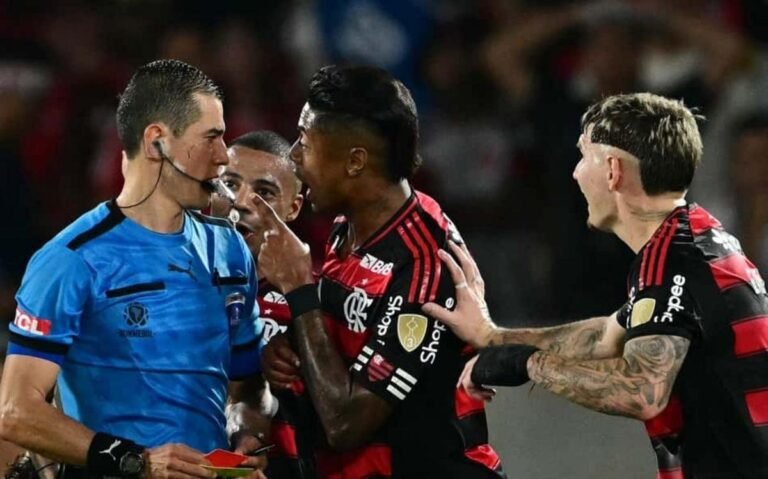


In an official statement, Flamengo raises questions about refereeing in Brazilian football and points to a history of favorable decisions for Palmeiras.
The debate surrounding refereeing in Brazilian football has regained momentum, especially after the end of the World Cup. At the center of the discussions is the widespread perception that a specific club has consistently benefited from refereeing decisions, a view that, according to Flamengo‘s official statement, transcends sporting rivalry and is supported by concrete data.
The Rio de Janeiro club’s statement highlights the need for greater reliability and transparency in decisions that directly affect the course of competitions, from match results to the race for titles and qualifying spots.
Statistical Data Evidences Disparity
A survey by Espião Estatístico, from ge, was cited in the statement to support the concerns. The numbers reveal that since the implementation of the VAR ranking in 2020, Palmeiras has had the highest number of decisions changed in their favor (65) and the lowest number of decisions against them (47) among the major clubs. This results in a positive balance of +18, the highest in national football, in addition to leading in total VAR interventions.
Furthermore, according to the statement, the current edition of the Brasileirão continues this trend. Palmeiras ranks as the fifth team that commits the most fouls to receive a yellow card (averaging 6.72 fouls per caution), while their opponents receive more yellow and red cards when facing them. Although an isolated statistic does not prove favoritism, the statement emphasizes that these accumulated statistics over seven seasons fuel the persistent debate about refereeing.
On-Field Behavior and Pressure on Referees
Flamengo‘s official statement also reflects on the behavior of players and coaching staff during matches. It has become common to observe the tactic of surrounding referees, with ostentatious complaints and the adoption of a victim stance, even on clear plays or minor infractions. The club classifies this attitude as a studied and coordinated action that impacts the officiating of games.
While acknowledging the investments by the CBF and the advances made by the Referees’ Committee in training, the disclosure of VAR audios, and new technologies, Flamengo emphasizes:
It is not they who execute the rules that, eventually, end up deciding games.
The text mentions the case of the match between Vitória and Palmeiras, where decisions were made by the on-field referee, Alex Gomes Stefano, and the video assistant referee, Marco Aurélio Augusto Fazekas Ferreira.
The Need for Fair Play and Clear Criteria
Flamengo reinforces the importance of referees being held accountable for serious errors and for failing to curb systematic misconduct, including the pressure exerted even on simple plays. The club cites the example of the World Cup, where players and referees, many of whom officiate in Brazil, adhered to the fair play rule, a behavior that should be replicated on the national stage.
For Flamengo, Brazilian football should prioritize the spectacle on the field over discussions about refereeing. This will only be achieved when referees apply clear criteria and stop rewarding teams that use pressure throughout the game as a strategy. The final message underscores that the rules must be followed by everyone, including referees, to ensure the necessary credibility for a sport that is both a passion and a major business.
Equipe M360