

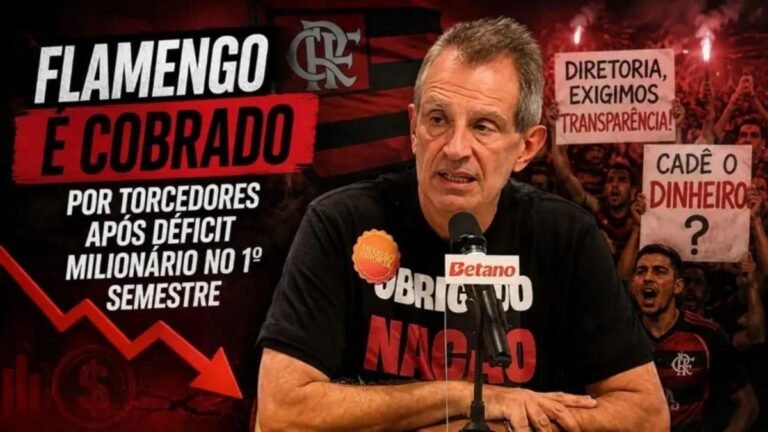
Flamengo Under Pressure: Councilors Demand Explanations and Transparency Following a R$ 33.8 Million Deficit in the First Half.
The financial landscape of Flamengo, one of Brazil’s largest football clubs, has once again stirred the behind-the-scenes atmosphere at Gávea. The release of financial statements showing an accumulated deficit of R$ 33.8 million in the first six months of 2026 has triggered an immediate reaction from a group of councilors. They have formally submitted documents, demanding greater transparency from the management and the implementation of statutory measures for the club’s sound governance.
The repercussions of the financial report highlight the importance of governance in football, where sporting passion meets administrative responsibility. The councilors’ demands aim to ensure that Flamengo’s planning and budget execution align with best management practices and the institution’s interests.
Councilors Demand Transparency from Management
Twelve Flamengo councilors directed their official letters to the presidents of the Deliberative and Fiscal Councils, Ricardo Lomba and Paulo Roberto Gomes, respectively. The main request is the reinstatement of the annual budget disclosure on the official website, a practice that was halted in 2024. They also demand the presentation of the first-half 2026 budget execution reports, with details on financial projections and the identified deficit.
The group has requested that the Fiscal Council summon the management to present the 2026 budget within 48 hours. Furthermore, the councilors advocate for a rigorous analysis of the application of Article 146 of the club’s Bylaws, which addresses the potential suspension of the Board of Directors‘ autonomy in scenarios of financial imbalance.
Flamengo’s Bylaws Provide for Suspension of Management’s Autonomy
The basis for the councilors’ demands lies in Article 146, item III of Flamengo’s Bylaws. This section clearly states that the management’s autonomy can be suspended if quarterly balance sheets reveal an accumulated deficit exceeding 3% of the revenue projected in the approved budget.
If this condition is confirmed, the impact would be significant: all contracts, agreements, loans, and revenue anticipations would require prior authorization from the Board of Directors. This measure would remain in effect as long as the financial irregularity persists, aiming to protect the club’s interests.
As of now, Ricardo Lomba and Paulo Roberto Gomes have not publicly commented on the requests.
Criticism of the Deliberative and Fiscal Councils
The submitted documents also include direct criticism of the Deliberative and Fiscal Councils. In the letter addressed to the Deliberative Council, the councilors accuse Ricardo Lomba of negligence for failing to present budget execution monitoring reports throughout 2025, the year he assumed the presidency.
Regarding the Fiscal Council, the group asks Paulo Roberto Gomes to officially demand the delivery of the 2026 budget from the management. Additionally, they request an analysis of the application of Article 146 to prevent potential liability for the members of the Fiscal Council themselves.
The documents also mention Article 69 of the Bylaws, which deals with the joint liability of presidents and vice-presidents in cases of losses or acts deemed detrimental to Flamengo due to negligence in the performance of their duties.
Flamengo Justifies Deficit by Investments in the Squad
In its most recent balance sheet, Flamengo explained that the negative result is primarily due to an accounting amortization of R$ 192.4 million. This amount is linked to the economic rights of players signed during the January transfer window, such as the acquisition of Lucas Paquetá, which cost over R$ 315 million.
The club’s management argues that the deficit is a natural consequence of the substantial investments made in building the squad.
Flamengo also emphasized that, by disregarding player trading operations and the financial effects of the 2025 Club World Cup, the recurring performance in the first half of 2026 would be the best recorded in the last five years, indicating operational financial health.
Flamengo‘s situation highlights the complexity of managing a football club, where investing in top-tier players must be balanced with fiscal responsibility and transparency.
The councilors’ demands, whose names include: Alvaro Luiz Ferreira, Carlos Bogel Borges, Eduardo Olivieri, Guilherme Pollastri Gomes da Silva, Julio Cesar Gomes da Silva, Julio Frederico Pollastri Gomes da Silva, Luiz Desiderati Junior, Marcelo Haberlehner, Marcelo Vargas, Maria Cristina da Cruz Silva, Otabio Katsuo Nakamura, and Wallim Cruz de Vasconcellos Junior, reflect the pursuit of more accountable management aligned with statutory principles.
The outcome of this internal pressure could influence the club’s management’s next steps, especially in planning for future transfer windows and maintaining the balance between sporting performance and financial health.
By