
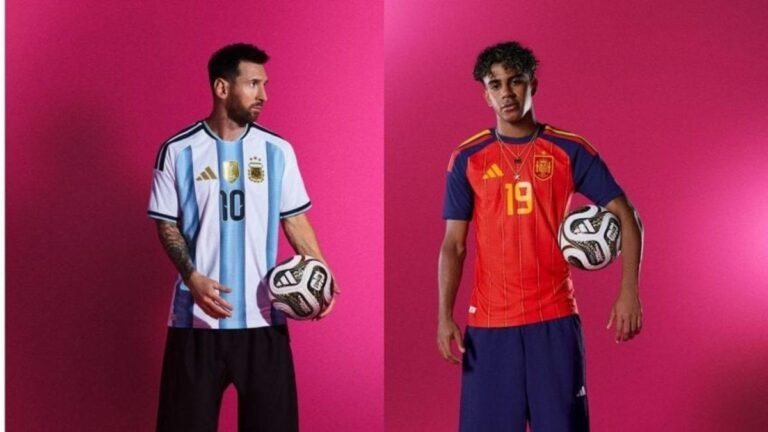
With Spain and Argentina in the final, Adidas secures the World Cup title and reaffirms its global football hegemony, surpassing rival Nike in a brand showdown.
The World Cup is about to crown a new champion, but even before the ball rolls for the grand final between Spain and Argentina this Sunday, one giant can already celebrate: Adidas. With both national teams sponsored by the German brand qualifying, the outcome of the final is already guaranteed for the company, solidifying a strategic victory and an undeniable dominance over its main competitor, American-based Nike.
The excitement gripping Argentine and Spanish hearts over their teams’ advancement to the final is mirrored in the realm of sports marketing. The battle fought on the pitches, culminating in Spain’s dramatic victory over France and Argentina’s win against England in the semifinals, has had an impact that transcends the sport, reaffirming the strength of the brands driving global football.
The Path to Glory and Strategy
The World Cup semifinals were true battlegrounds not just for the athletes, but for the sports equipment giants. On one side, Lamine Yamal’s Spain overcame France, outfitted by Nike. On the other, Lionel Messi’s Argentina eliminated England, also a Nike-sponsored team, sealing an exclusive Adidas final.
The decisive clash between Spain and Argentina will take place next Sunday, July 19, at 4 PM Brasília time, at the iconic MetLife Stadium in East Rutherford. On Saturday, the third-place playoff will pit France against England, a match entirely featuring Nike-sponsored teams, leaving only a ‘consolation prize’ for the swoosh brand.
Adidas’s Hegemony in Numbers
This exclusive Adidas final is no mere coincidence. The German brand is set to claim its 7th title in 15 World Cups contested since 1970, a period when sports equipment suppliers began to play a pivotal role. In contrast, Nike has only two titles, won with Brazil in 2002 and France in 2018.
With this outcome, Adidas guarantees the World Cup for the 4th time in the last 5 tournaments, an achievement that demonstrates its ability to remain at the top. Recalling the recent finals, Adidas’s constant presence is undeniable:
In 2006, Puma (Italy) vs. Adidas (France);
In 2010, Adidas (Spain) vs. Nike (Netherlands);
In 2014, Adidas (Germany) vs. Adidas (Argentina);
In 2018, Nike (France) vs. Nike (Croatia);
In 2022, Adidas (Argentina) vs. Nike (France).
Football Beyond the Pitch
The World Cup, organized by FIFA every four years, is much more than a sporting tournament; it is a massive for-profit private event. The selection of squads, as in Brazil’s case by the CBF, reflects a private operation where a ‘call-up’ is a strategic invitation, driven by vast commercial and marketing gains.
It is crucial to understand that it is not the country itself that is represented on the field, but a team assembled by a private entity, such as the CBF. This commercial and sports marketing landscape further highlights the strategic importance of having the finalist national teams wearing one’s logo, as Adidas has achieved in this edition.
A Triumph That Reverberates in the Market
Adidas’s strategic victory in this World Cup, regardless of who lifts the trophy between Spain and Argentina, is a milestone in the sports marketing landscape. It reinforces the German brand’s investment power and vision, consolidating its leadership and sending a clear message to Nike: the battle for supremacy on the pitches and in the hearts of fans is far from over, but, for now, Adidas reigns supreme. It is the passion for football driving the global market.