
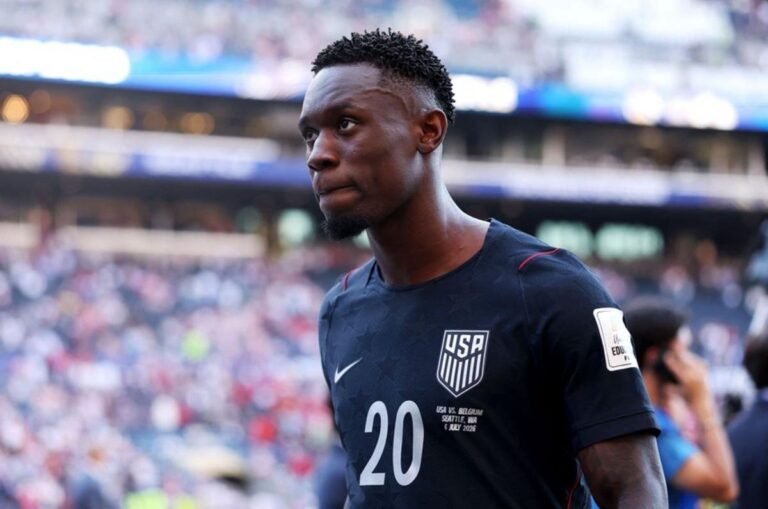
The White House once again defends its intervention in the Balogun case at the World Cup, citing a duty to protect the tournament and ensure fairness after a controversial FIFA decision.
The 2026 World Cup, poised to ignite global football emotions, is already at the heart of a controversial discussion that extends beyond the pitch. The controversy surrounding forward Folarin Balogun and his suspension, later reviewed by FIFA, has taken an explosive new turn. The White House, through Andrew Giuliani, the representative responsible for organizing the tournament in the United States, publicly reaffirmed the U.S. government’s involvement in the process that led to the player’s clearance.
This stance by the United States government reignites the debate over the autonomy and independence of decisions made by football’s highest governing body. The speed with which Balogun‘s sanction was overturned raised serious suspicions of political influence, especially after the confirmation of contact between then-President Donald Trump and FIFA leadership. Now, the defense of governmental intervention calls into question the impartiality expected of a competition of such magnitude.
The On-Field Controversy and FIFA‘s Reversal
The confusion began in the round of 16 when Balogun received a direct red card in a match against Bosnia. A decision that, initially, would have ruled him out of the quarterfinals. However, days later, FIFA unusually re-evaluated the incident, overturning the suspension and allowing the forward to play in the decisive clash against Belgium.
The immediate reversal of the punishment sparked a wave of criticism from various sectors of football. Officials, fans, and analysts expressed concern about the transparency of the process, pointing to potential external interference. The swiftness of the decision fueled questions about the fairness of the organization’s disciplinary procedures.
Trump, Giuliani, and the Justification for Intervention
Suspicions solidified when former President Donald Trump publicly confirmed he had contacted the FIFA president to discuss the case. Now, in an interview with the renowned Italian newspaper Gazzetta dello Sport, Andrew Giuliani detailed the reasons that, according to him, motivated the U.S. government’s involvement.
First, the referee had already been the subject of an investigation in Brazil related to red cards. Second, we believed that VAR was used improperly in that incident. Finally, it was our duty to protect American taxpayers, who have invested billions of dollars in this competition, and to ensure a fair World Cup.
Defending the Event’s Credibility
The intervention, according to Giuliani, had a greater purpose: to preserve the credibility of the World Cup, an event that will be hosted in the United States. He emphasized that the action was guided by a philosophy of justice, both on and off the field, aiming to ensure the integrity of the tournament.
The episode became one of the World Cup‘s biggest controversies, sparking an intense and necessary debate about the independence of FIFA‘s disciplinary decisions. Transparency and impartiality are fundamental pillars for the legitimacy of any sporting competition, and the Balogun case has cast a shadow over these principles.
The White House‘s reaffirmation of its intervention in the Balogun case is not merely a defense but a stance that could redefine the relationship between politics and sports in global-scale events. As the 2026 World Cup approaches, the controversy serves as a warning to FIFA and organizers about public perception of justice and integrity in their competitions. The next steps and how the organization handles these accusations will be crucial for its reputation and the future of football governance.