

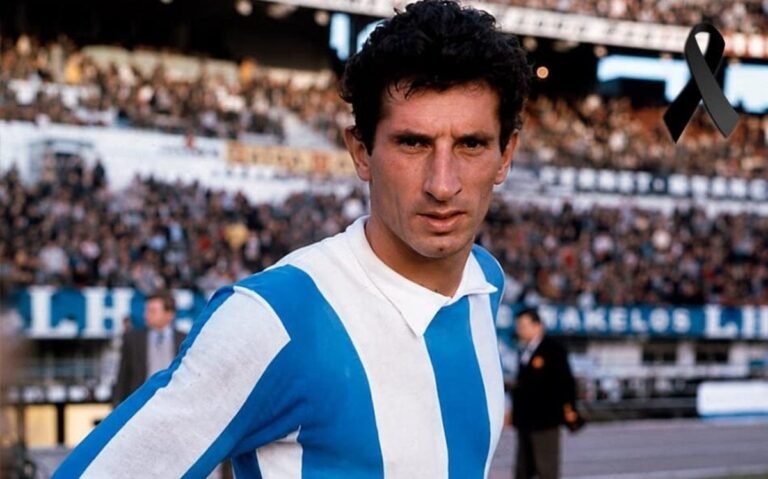
The loss of Antonio Rattín, an icon of Boca Juniors, deeply resonates throughout Argentine football. His legacy transcends titles, having redefined on-field communication with the inspiration for yellow and red cards.
The world of football bids farewell to one of its most emblematic figures. This Saturday, at 89 years old, Antonio Ubaldo Rattín, legendary midfielder for Boca Juniors and the Argentina national team, passed away, leaving an immense void and a legacy that forever shaped how the sport is played and understood. His passing plunges Argentine football into mourning, evoking memories of an athlete of rare grit and global impact.
Beyond his titles and vigorous on-field performance, Rattín gained global notoriety for a transformative incident at a World Cup. A moment of misunderstanding on the field not only halted a decisive match but also gave rise to one of the most crucial innovations in refereeing history, changing the dynamic of communication and discipline in the sport.
A “Xeneize” Trajectory of Grit and Glory
Antonio Rattín‘s story is intrinsically linked to the blue and gold colors of Boca Juniors. Between 1956 and 1970, the defensive midfielder defended the club with unmatched passion, building a legendary career. His debut was in a vibrant Superclásico against River Plate, sealed with a 2-1 victory, a prelude to his greatness. Over 382 official matches, he scored 28 goals and won six trophies, including five national championships and the 1969 Copa Argentina. In 1963, he led Boca Juniors to the Copa Libertadores final, where they faced Pelé‘s powerful Santos, in a historic confrontation.
The Day Protest Became History
The most remarkable chapter of his international career occurred in the quarterfinals of the 1966 World Cup, in London, against host nation England. At the iconic Wembley Stadium, Rattín was sent off by German referee Rudolf Kreitlein. The absence of a visual warning system created communication chaos: unable to understand the verbal order and the referee’s gestures, the Argentine captain refused to leave the field, demanding a translator to comprehend the punishment.
This stalemate, which halted the game for nearly ten minutes, is a portrait of the “grit” that Rattín personified. His reluctance to leave, followed by an act of defiance in grabbing the corner flag with British symbols as he walked to the locker rooms amidst public protests, not only marked the match, which ended in a 1-0 English victory, but also ignited a historic rivalry between the two nations in football.
The Legacy That Changed Football
The linguistic confusion spearheaded by Rattín at Wembley was not in vain. Observing the scene, Ken Aston, then head of FIFA‘s referees’ committee, realized the urgency for a universally understood method of punishment. The inspiration came from traffic lights: yellow to warn, red to send off. Thus, yellow and red cards were born, first implemented at the 1970 World Cup, revolutionizing discipline and communication in the sport.
Even without having won major titles for the Argentina national team, Rattín cemented his immortality in football. He participated in the 1962 and 1966 World Cups, and his name was etched in history not only for his skill but for his legendary stubbornness which, ironically, paved the way for a common language on the field. A sculpture in his honor at the Boca Juniors museum eternalizes the player whose audacious attitude redefined the dynamic of world football.
The passing of Antonio Rattín is a vivid reminder of how an individual’s passion and “grit” can transcend the playing field and leave an indelible mark on history. His protest in 1966 was not just an act of defiance but a catalyst for a necessary evolution in refereeing, making football clearer, fairer, and more understandable for everyone. Rattín‘s legacy lies in the universality of yellow and red cards, which today are an intrinsic part of the sport, an eternal tribute to the one who dared to question the rules and, in doing so, rewrote them forever.